 nominate Lesser Black-backed Gull (L. f. fuscus)
(last update:
Amir Ben Dov (Israel)
Hannu Koskinen (Finland)
Mars Muusse (the Netherlands)
fuscus 1cy July
fuscus 1cy Aug
fuscus 1cy Sept
fuscus 1cy Oct
fuscus 1cy Nov
fuscus 1cy Dec
fuscus 2cy Jan
fuscus 2cy Feb
fuscus 2cy March
fuscus 2cy April
fuscus 2cy May
fuscus 2cy June
fuscus 2cy July
fuscus 2cy Aug
fuscus 2cy Sept
fuscus 2cy Oct
fuscus 2cy Nov
fuscus 2cy Dec
fuscus 3cy Jan
fuscus 3cy Feb
fuscus 3cy March
fuscus 3cy April
fuscus 3cy May
fuscus 3cy June
fuscus 3cy July
fuscus 3cy August
fuscus 3cy Sept
fuscus 3cy October
fuscus 3cy Nov
fuscus 3cy Dec
fuscus 4cy Jan
fuscus 4cy Feb
fuscus 4cy March
fuscus 4cy April
fuscus 4cy May
fuscus 4cy June
fuscus 4cy July
fuscus 4cy Aug
fuscus 4cy Sept
fuscus 4cy Oct
fuscus 4cy Nov
fuscus 4cy Dec
fuscus ad Jan
fuscus ad Feb
fuscus ad March
fuscus ad April
fuscus ad May
fuscus ad June
fuscus ad July
fuscus ad Aug
fuscus unringed Aug
fuscus ad Sept
fuscus ad Oct
fuscus ad Nov
fuscus ad Dec
Sub-adult fuscus (4cy) in July are very hard to tell from full adult birds. Sometimes, sub-adults may show features of immaturity, like limited black spots on the tail-feathers, some speckling in the iris, black on the upper mandible or obvious pale brown bleached greater wing-coverts. However, a large proportion of sub-adults completely lack such immature characteristics. Lars Jonsson, who did extensive research on immature fuscus, hesitates to name features to isolate a consistent third-summer type plumage. His research is summarized on this page, together with some comments on the appearance of (most 2cy& 3cy) intermedius in the Netherlands and NW France.
On this page, you'll find a summary of “Baltic Lesser Black-backed Gull Larus fuscus fuscus – moult, ageing and identification”, by Lars Jonsson, as published in Birding World Volume 11 number 8, 1998. We have added some extra images, most of ringed birds (so proved origin). The article by Jonsson concentrates on the field identification of fuscus. He presents new (1998) information for the identification and ageing of immature birds. As the article was published in the British magazine Birding World, Jonsson emphasizes on identification of out of range birds in the U.K. or continental NW Europe. He stresses that "basic understanding of the moult, plumage development and migration of the form fuscus are necessary for correct identification of such birds".
This article is often referred to, and for a while, was standard reference and only literature for the Dutch Rarity Committee to reject or accept out of range fuscus for the Dutch list. Nowadays, with better understanding of the taxon intermedius, it seems wise to focus on ringed birds only. On this page, we try to bring together information of graellsii and intermedius, which is relevant in identification of fuscus. Most of the data were already published on various pages in the Lesser Black-backed Gull Section or could be found on the "discusfus" page.
Moult, ageing and identification of fuscus - Lars Jonsson
Materials and methodsJonsson studied fuscus on Gotland, SE Sweden, where it is a common breeder in a few large colonies. He also visited museum collections at Tring, Stockholm, Gothenburg, Copenhagen, Helsinki and New York. He observed graellsii and intermedius in Sweden, Denmark, England, Spain and Morocco. The ringing recoveries of Fenno-Scandinavian fuscus in Western Europe are analysed briefly, mainly to see if they support evidence for the European status of fuscus. To increase objective measurements on museum specimen, Jonsson used a 20 steps Kodak grey scale to classify dead skins.
Systematic position, nomenclature and behaviourMost authors treat Larus fuscus as a single species, represented in Europe by three subspecies: graellsii, intermedius and fuscus (e.g. Barth 1975, Grant 1982, Cramp 1983). However, from the early 90’s authors stressed the differences between western and eastern birds (Strann & Vader 1992, Sibley & Monroe 1993). Based on genetic research by Sangster in 1998, the Dutch Rarity Committee decided to separate Baltic fuscus from the western forms graellsii and intermedius, which were lumped and regarded “the” Lesser Black-backed Gull. Indeed, there are a few obvious features in fuscus that isolate it from the other two taxa; nonetheless it is not easy to draw a definite line between fuscus and graellsii/intermedius. Geographic isolation of fuscus may have resulted in these differences, but still, the shared genetic heritage is obvious when observing the three forms. Jonsson doesn’t take strong position in the nomenclature debate, as he feels uncomfortable in the arrangements purposed; i.e. Greater Black-backed Gull, Lesser Black-backed Gull and Baltic Gull.
Identification in the literatureEarlier literature focused most on adult bird and mention differences in upper-part coloration and structure. In his article, Jonsson enlarges upon the immature plumages as well, especially second and third calendar year birds.
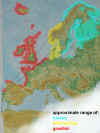
The map shows the approximate ranges of fuscus, intermedius and graellsii, as the late Edvard Barth classified LBBG's after intensive field research. Already in the 60's, Barth proposed to treat intermedius as a subspecies, or at least classify it closer to graellsii than to fuscus. Apart from coloration and biometrics, graellsii and intermedius are different from fuscus in egg laying date and migration pattern, where fuscus clearly differs from the intermedius/graellsii group. Ring recoveries revealed fuscus to migrate S and SE. Intermedius catches up with graellsii on their migration SW to Portugal and further south along the NW African coast. Birds from South Sweden migrate south, at least a part of the population can be found in E Germany and further south in S Italy on migration. Probably the birds from Öland (which have been recorded flying SW) meet birds from Denmark on the way to S Italy and further south into Africa. |
Distribution in Europe
At the turn of the century, Lesser Black-backed Gull showed a much-restricted breeding range than today. Graellsii could be found in the U.K. and the Faeroes, intermedius was bound to western Scandinavia and fuscus was widespread in the Baltic Sea, northern Fenno-Scandinavia and northwest Russia. Graellsii expanded northwards to Iceland in the 1920’s and westwards to the Netherlands in the 1930’s. A dramatic increase followed, with influences of both graellsii and Scandinavian intermedius in the Dutch colonies. These Lesser Black-backed Gulls are often referred to as “Dutch intergrades”. Similar birds nowadays breed along the French Atlantic coast and in the Spanish Ebro Delta. In the 1990’s, intermedius has increased its breeding area into former fuscus area: the Danish islands and the Lofoten area of northern Norway. (see Distribution Section).
At the same time, fuscus faced a dramatic decline, disappearing in most of the peripheral breeding sites, like the Kola peninsular in NW Russia (Filchagov 1992) and the southernmost Baltic. Several suggestions have been made for the fuscus decrease: predation by much stronger Herring Gulls, which are more abundant nowadays and human influences. People collect eggs from fuscus nests in NW Russia as nutritious food (Hannu Hoskinnen, pers. comm.).
Barth (1968) describes the division lines between intermedius and fuscus in Scandinavia. The two meet along the coast of central Norway near Tarva and in the waters of Kattegat, eastern Denmark. Birds from the island Anholt are intermedius and those from the island Saltholm (Oresund) seem to be belong to the taxon fuscus.
According Jonsson, the wintering quarters of intermedius can be found in the western Mediterranean (Italy and westwards), and only a fraction can be found in western Africa, south of the Sahara. Recent ringing programmes in southern Norway and the Netherlands indicate than many birds do migrate far south and can be found in Morocco, and further south along the rich fish coasts to Mauritania. There is at least one ring reading from inland Congo, an intermedius ringed in Norway. In migration distance, this bird resembles fuscus, which can be found in great lakes of the Rift Valley in eastern Africa or even S Africa. But fuscus spend the winter also further north: the Persian Gulf and eastern Mediterranean (Egypt, Israel).
How to find fuscus in western Europe
Jonsson studied local gulls in south Sweden, checking intermedius and graellsii among local fuscus and this is the basis for his paper. With the increase of western taxa, he finds 10% of resting gulls to belong to graellsii/intermedius in the late 1990’s. His advice for search fuscus in western Europe: gain good working knowledge of the variability within intermedius and graellsii by constant study of local gulls. To find out of range fuscus, one should take into account the main arrival and departure periods for fuscus. And understand the complicated moult pattern exhibited by fuscus. However, individual birds may be difficult to interpret accurately, and it’s probably best to focus on obvious individuals, with borderline fuscus candidates left unidentified until more information is at hand.
Jonsson targets three best options:
- First-summer birds in (June) July and August;
- Second-summer birds in late April – May and in July – August; and
- Adults in late August to September.
Jonsson stresses the difficulty of labeling small, slim and black-mantled birds arriving back from Africa in spring as fuscus. There is no 100% certainty in these birds, as all features may apply to intermedius as well. Added to this, adult fuscus from the southern Baltic has a mantle colour which overlaps to a high degree with intermedius. (See Barth's map).
Fuscus is a long-distance migrant and follows a south or southeasterly route to the winter grounds. Prior to migration, fuscus and intermedius forage both together in eastern Denmark, and from here some fuscus may take a wrong route, bringing them into the North Sea area. Ringing programs were started in eastern Scania and Blekinge (south-eastern Sweden), and from these sites 71 recoveries were made outside Sweden. Only two recoveries were made north or west of Denmark, 29 were from within Denmark (Bornholm excluded).
Same ringing programs in northern Sweden resulted in 50 recoveries outside of Sweden, with only two in Denmark. These birds apparently follow a more easterly route.
The recoveries of Swedish fuscus made in Denmark are mainly from September – October and a smaller peak in April – June. Limited numbers of fuscus from northern Norway and Denmark have been ringed, but none has ever been recorded in the North Sea area. Actually, there is no evidence of fuscus regularly occurring in the North Sea.
Sweden and Finland have ringing programs on larger scale with 15 recoveries in western Europe prior to 1998. Nine birds were juvenile / first winter birds and 5 birds were in 2nd calendar year or early 3rd calendar year. Only one adult has been discovered. A word of caution is necessary where juveniles are involved, as numbers can be influenced by misidentification of argentatus Herring Gulls when pulli were ringed. Nevertheless, there is evidence that some fuscus may follow a more westerly route, as two Finnish ringed birds have been rediscovered in Portugal and in Valencia, definitely outside the range of argentatus. Another 7 records come from north-western Africa (Spanish Sahara – Algeria), most probable fuscus as well. Interestingly, this is the main wintering area for intermedius, and it’s easy to construct a picture of these fuscus moving north again with intermedius flocks in spring, finding their way into the North Sea area.
Another 4 immature and 1 adult fuscus have been found west of the ordinary fuscus winter range in Africa: 2 from Mali and 2 from Senegal, and the adult from Guinea Bissau.
The main wintering grounds for fuscus must be located in tropical Africa. According Jonsson, the eastern Mediterranean host only small fuscus numbers, although the majority of ring recoveries from recent Finnish project come from Israel, probably due the more densely ornithologist network in Israel (Hannu Hoskinnen, pers comm.). It is normal for fuscus to winter on the Benin coast, as far west as Ghana, based on Swedish ring recoveries. Swedish fuscus can be found evenly distributed from Ethiopia to Ghana and here, in Ghana, intermedius is common as well. Jonsson believes that Swedish fuscus must follow a route straight south through central Europe (with records in Italy, Tunisia and Libya) and subsequent passage over the Sahara dessert in a straight line, supported by early reports of juveniles in sub-Sahara Africa (e.g. Chad, September 20th). This idea is further supported by evenly distributed Swedish ringed fuscus in Africa: 19 records in western Africa and 14 records in eastern Africa (24°E longitude). If one presumes a solely eastern route, a bias in eastern African records would be expected as well, Jonsson states.
Based on field experience, intermedius is generally larger and slightly more heavily built than fuscus. The difference between fuscus and British graellsii is very obvious, with fuscus looking long-winged and darker. Graellsii is more powerful with full breast and short rear end, not as attenuated as in fuscus. However, one must keep in mind the differences between small females and larger males.
The most prominent feature in fuscus is its very dark upper-parts, almost black and with a strong brown fruity mahogany hue on the older feathers. Although the difference between fuscus and graellsii is very obvious in this respect, fuscus is much harder to distinguish from intermedius. Moreover, judging absolute grey tones and brown hue in the field is difficult and is influenced by light conditions and observation circumstances.
The late Edward Barth, a Norwegian ornithologist working for the museum of Oslo, has written the most authoritative work on grey-tones of intermedius and fuscus (Barth 1966, 1968, 1975). The results are summarized on this page.
Fuscus is rather homogeneous in the central and northern Baltic Sea and in Finland (See map), where the upper-part grey value reaches Kodak 13-17 (mean 14.4), which is blackish-grey or darker. Jonsson believes that Barth’s work doesn’t allow strong conclusions for Denmark and Scania (southernmost Sweden, the contact zone), as birds were combined in the analysis. However, Barth only added one single bird from Scane to the Danish sample (see fig 2, page 63, Barth 1966, and compare table 5, page 69, 1966 with table 6, page 18, 1968), and the conclusion that intermedius from this area may reach grey tones as dark as fuscus from the heartland, still holds. Both in southern Norway and on the Swedish west coast, intermedius normally ranges between Kodak 11-13 (mean 11.7), including birds with grey tones similar to typical fuscus. Remember that fuscus was more widespread in the 1950’s-60’s and out of range fuscus may have influences Barth’s measurements, and also remember that fuscus was much more widespread at the turn of the century, when birds were added to museum collections.
Jonsson concludes: “the mere fact that a Lesser Black-backed Gull looks darker than a typical intermedius, and may even appear black-looking, is not enough for a sub-specific identification”. Jonsson's material shows an approximate 15% overlap between fuscus from the east Swedish coast and intermedius from west Sweden. This means that every seventh or eighth intermedius will look like a pale fuscus, and visa versa.
Figure 6 from Barth, 1968. Statistical analysis of colour value (ordinate), and chroma notation (abscissa) of the three forms of L. fuscus. The Danish population is considered to be a particularly mixed one. |

Barth’s research also enlarged upon the brown hue (chroma) in old feathers, a feature commonly encountered in fuscus. Intermedius retains a neutral lead-grey tone, even when the feathers are old. Bleached intermedius scapulars and wing-coverts should be described as cold brown or milky brown, where fuscus show a deep fruity warm brown mahogany hue on old feathers.
A word of caution: sub-adult birds of both taxa show browner old feathers. Research of Dutch intergrades in the Netherlands revealed that birds breeding in the Netherlands may show strong brown hue on old feathers as well (see a dark Dutch bird here and brown hued birds here and here).
The wing-tip pattern in the three forms graelllsii, intermedius and fuscus show severe overlap, but large mirrors on both P9 and P10 are rare in fuscus and common in (male) graellsii.
Several authors mention the late start of the primary moult in adult fuscus, only after arrival at the wintering grounds. However, adult fuscus regularly start moulting the innermost primaries on the breeding grounds (although late). Hario (1982) already established this phenomenon (see summary on this page). Jonsson surveyed resting birds, and he estimates 60% of adult-like fuscus from July to mid-September to have started shedding the inner primaries P1 or P1-P2 by the end of August. Only very rarely adult-like birds have dropped P3 as well.
This is different from what generally can be found in intermedius and graellsii. Intermedius in late-August or early-September are normally more advanced in primary moult, with P4-P6 growing at this time (See here). Peter Stewart, doing research on graellsii in the U.K., found only one out of 98 birds from September 01, which dropped just P1 and P2. Jonsson stresses the apparent difference: intermedius with advanced moult in the primaries and normally cold grey scapulars or feathers with a ‘milky brown’ hue on the old feathers. In the mean time, when birds are growing P4, they normally show active moult in the wing-coverts as well, replacing the median, lower lesser coverts and the outer greater coverts. This strongly contrast with fuscus, which show delayed moult: at most the two inner primaries dropped and strong warm brown mahogany hue on the old feathers. Active moult in the wing-coverts is suspended until arrival at the wintering grounds.
In the Netherlands, we regular check 1.000's of Lesser Black-backed Gulls by late August and early September (see here and here). On all occasions, several birds showed delayed moult in the primaries and this is what Jonsson mention as the ‘potential pitfall’. However, says Jonsson, still a 40% of Swedish fuscus depart to Africa and the Mediterranean without a single sign of primary moult. This is very rare in intermedius (although still possible).
Jonsson summarizes the correct combination of features in adult autumn fuscus:
- Unmoulted inner primaries,
- A white, unspotted head, and
- Dark, blackish, upper-parts with 50% or more brownish-black scapular feathers.
Also, the out of range bird has to be structurally distinct from its neighbours, to be identified as vagrant fuscus in late August or early September. A word of caution: remember that some graellsii and intermedius may arrest the primary moult, so show a full primary set in autumn (see here and here).
Fuscus start / continue the primary moult on the wintering grounds, and finish this primary moult in February – March, just prior to northward migration. Some birds may migrate with growing outer primaries, some other adults include the innermost primaries again in the moult in spring. Hence, they show fresh primaries in spring, but remember that its not uncommon to find intermedius and graellsii with recently replaced inner primaries in spring as well. Therefore it seems wise to focus on adult birds in autumn.


First calendar year: juvenile fuscus
It is difficult to describe a “typical” juvenile fuscus, as they are as variable in this plumage as other large white-headed gulls. In general they show more contrast than juvenile intermedius and graellsii, according to Jonsson. However, many birds are not conspicuous in this respect. Jonsson focuses on “the personality” of fuscus, rather than on diagnostic features, as there is probably not a single definite characteristic.
The post-juvenile moult in the scapulars and sides of the breast may start as early as late August. Fuscus migrate quickly; mirrored by early arrival dates in Africa: e.g. Uganda September 24, Angola September 29, and Zaire October 04. Juvenile fuscus arrive in (almost) complete juvenile plumage (advanced birds have the scapulars moulted), but they probably start moulting rapidly. The new scapulars are dark slaty-grey with a blackish wedge-shaped shaft-streak. Some show an anchor pattern on the new second-generation scapulars, according Jonsson. Both patterns can be found in intermedius as well.
 LBBG intermedius 1cy J07J, September 22 2002, Boulogne/Mer, NW France. Ringed in Norway. LBBG intermedius 1cy J07J, September 22 2002, Boulogne/Mer, NW France. Ringed in Norway. |
 LBBG 1cy Stavanger, August 28 2003, IJmuiden, the Netherlands. Ringed in Norway. LBBG 1cy Stavanger, August 28 2003, IJmuiden, the Netherlands. Ringed in Norway. |
 LBBG intermedius 1cy Stavanger 4238324, September 22 2002, Boulogne/Mer, NW France. A bird ringed in Norway last summer. LBBG intermedius 1cy Stavanger 4238324, September 22 2002, Boulogne/Mer, NW France. A bird ringed in Norway last summer. |
Second calendar year: fuscus in spring
On the wintering grounds, the wing-coverts are moulted when most of the scapulars have been replaced; probably in the same sequence as in the complete moult (basic moult), and the coverts are all or almost all replaced by late January or February. Considering the wear of these wing-coverts in spring in Scandinavia, they must have been moulted within a very short period, as in many birds the abrasion and bleaching of the feathers is almost equal in the complete panel. Only after finishing the moult in the wing-coverts, 2cy fuscus start to moult the fight feathers in February according to Jonsson. He described ten 2cy fuscus from late January in Israel and none had shed any primary, but he doesn't enlarge upon the covert moult stage.
In museum collections, Jonsson found four birds: one 2cy fuscus from late January, growing P1 and P2. Two other birds from April, found in Angola also showed moult in the primaries (moult scores 13 and 46) and another bird from Aden almost finished its primary moult in early May (moult score 39). For explanation of moult scores: see Topography Section.
Primary moult starting in February just fits in the fuscus picture, as this replacement takes over 4 months in large white-headed gulls. Thus, 2cy birds are just in time to finish this moult to migrate north again by late-May – June.
From 1995 to 1998 Jonsson described 2cy fuscus after arrival at Gotland, south Sweden, and these birds showed a wide range of variation. Most 2cy birds finished moulting all of the flight feathers by late April and May, others arrested moult in the primaries prior to migration. However, a small part of 2cy fuscus return in Scandinavia with all flight feathers still juvenile.
The exact extend of secondary moult is not mentioned by Jonsson (as this is hard to obtain from field research), but he presumes that most 2cy birds have the secondaries largely replaced for second-generation feathers. Most birds (Jonsson mentions “second summer”, but this should be “first” summer probably) have moulted the rectrices as well.
Contrary most literature, Jonsson presumes that 2cy fuscus do regularly migrate north, but the position of the wintering grounds (either Mediterranean or Africa) of these returning birds is unknown. Jonsson estimates that “a substantial proportion of the total number of this age-class” is involved. The vanguard of second calendar year birds normally returns July 01, after a one-month journey north.
Jonsson doesn't further specify on the "substantial proportion" of 2cy birds, which is a pity. Indeed, most literature mention that most of 2cy birds remain at the wintering grounds or rich feeding grounds further north. The picture of low number of 2cy in Scandinavia is reflected by ring-recoveries of 2cy intermedius, which normally do not spend the summer months in S Norway but further south along the Atlantic coast (Nils Helge Lorentzen, pers comm). The same seems to be true for Finnish fuscus. From April onwards, many colour-ringed 3cy and older birds find their way north again to Tampere dump, but only low numbers of ringed 2cy fuscus are encountered (Markku Kangasniemi& Hannu Hoskinnen, pers. comm.).
Second calendar year fuscus in autumn – third calendar year fuscus in spring
The second renewal of the primaries may start during the summer months in Scandinavia, but most will moult the primaries after migration to Africa again. Jonsson examined eight birds from museum collections and there is a lot of irregularity involved in moult sequences of autumn 2cy birds. In his opinion, 2cy birds in autumn are not moulting the primaries in the ordinary sequence (from P1 to P10), but in “waves”. Jonsson doesn’t enlarge upon these waves, but the final result, when 3cy birds arrive in spring, will be obvious visual moult steps in the primaries (normally at P6, P7, P8 or P9). This pattern of arrested moult is regularly found in 3cy fuscus and must be a common characteristic.
Jonsson examined two 2cy birds found in Africa in October; both were actively moulting the outer primaries. This is a nice example of “continuation after suspension”. Moult of the primaries continues after suspension in the outer primaries (moulted to second-generation) and subsequently birds start at P1 again (moulted to third-generation). Prior to spring migration, 3cy fuscus arrest primary moult again in the outer primaries, resulting in the obvious moult step when they return in Sweden by late-April and early-May. The obvious mirror on P10 can be explained by the late requirement of this second-generation P10, which is therefore more adult-like in appearance.
Identification of 2cy fuscus from intermedius/graellsii
If one attempts to find fuscus in NW Europe, the most obvious option is to look for 2cy birds with a new set of flight feathers in July or August. Ordinary graellsii and intermedius start the primary moult by the end of April or from May onwards. Hence, 2cy birds with new primaries in July should be fuscus, if other (structural) features support this identification.
In 2cy July fuscus, the head feathers are moulted and look scruffy (moth-eaten). Some birds seem to renew all the body-feathers and look fresh in summer. The bill is largely dark with pale base but may show red at the gonys. The upper-parts consist of old sepia brown worn second-generation feathers, mixed with almost black fresh third-generation feathers. Many birds renew the wing-coverts on the wintering grounds, and these coverts look worn when they return in Scandinavia. The second-generation coverts show little pattern, although notches may be visible on the greater coverts.
Jonsson stresses the difference between these coverts in fuscus and intermedius, but this is a too simplified picture. Wing-covert moult, tail-feather moult and secondary moult in intermedius is not necessarily initiated in summer. Many birds start this moult much earlier, already on the wintering grounds and are very reminiscent of fuscus in this respect. Moreover, intermedius may start the scapular moult to third generation as early as June. However, it has still to be proven that 2cy intermedius may return with second-generation flight feathers in spring, as many fuscus do. Such birds can be found in NW Europe, but none was ringed so far.
On Gotland, Jonsson found several 2cy fuscus which failed to moult the flight feathers on the wintering grounds, thus in line with other European gull species. He describes two of such birds in his article, to emphasize the differences with graellsii/intermedius. One bird, he admits, would be difficult to identify as fuscus outside the normal range, but the other one shows diagnostic features, i.e.:
- All wing-coverts second-generation, where graellsii/intermedius show juvenile wing-coverts and fresh second generation coverts growing in,
- Primary moult score of 11, which is too low for typical graellsii/intermedius on July 09,
- New rectrices, where graellsii/intermedius are in active rectrices moult.
Research on 2cy intermedius and graellsii in the Netherlands reveal these features can be found in intermedius as well. Second generation wing-coverts and tail are not uncommon in June. Furthermore, it seems there is no species of large white-headed gull with a primary moult score range as large as in Lesser Black-backed Gull and intermedius with primary moult score of 2 -exceptionally low- can be found by mid-July. (See 2cy LBBG July Section).
Identification of 3cy fuscus from intermedius/graellsii
3cy fuscus is probably the most rewarding plumage to look for in NW Europe. Jonsson accentuates the colour of upper-parts and stage of moult in the wing-coverts. The fresh feathers are much darker, blackish, and 3cy fuscus is much advanced in wing-coverts moult compared to graellsii/intermedius. This is not correct. Many 3cy intermedius show a complete adult-like wing-covert panel, and as Jonsson stated earlier, the upper-part grey-tone of intermedius may overlap with fuscus.
Jonsson states: “I would positively identify a second-summer Lesser Black-backed Gull in May showing predominantly dark wing-coverts and very fresh inner six to eight primaries as fuscus”. Jonsson examined 9 intermedius from museum collections, which were all much graellsii-like. This sample doesn’t reflect the variation found in the field by us. Arrested moult in the primaries is not uncommon in intermedius, and it is found in graellsii too. Several ringed intermedius and Dutch intergrades have been observed, showing arrested moult at P6, P7, P8 or P9. Interestingly, this advanced moult in the primaries correlates with advanced moult in the wing-coverts, resulting in a more adult-like appearance. Although arrested moult in 3cy intermedius is not common in May (about 5%), it starts to be more common in June (estimated 10% in 2003). Although Jonsson describes the tail of 3cy intermedius usually to be of one single generation, this is simply not true: plain white tail-feathers are commonly growing in 2cy October-November birds or in 3cy March-April birds. When returning in the Netherlands, 3cy intermedius may show a plain white tail in June.
Identification of sub-adult fuscus
Sub-adult fuscus look very adult-like, although a few bleached brown wing-coverts or black spots in the tail may still be present. Jonsson hesitates to name features to isolate a consistent third-summer type plumage.
References (selection)Baker, R.R. 1980. The significance of the Lesser Black-backed Gull to models of bird migration. Bird Study 27:41-50.
Barth E.K. 1966. Mantle colour as a taxonomic feature in Larus argentatus and Larus fuscus. Nytt Mag. Zool. 13, 56-82.
Barth E.K. 1968. The circumpolar systematics of Larus argentatus and Larus fuscus with special references to the Norwegian population. Nytt Mag. Zool. 15, suppl: 1-50.
Barth E.K. 1975.Taxonomy of Larus argentatus and Larus fuscus in north-western Europe. Ornis. Scand. 649-63.
Bergman, G. 1982. Population dynamics, colony formation and competition in Larus argentatus, L. fuscus and L. marinus in the archipelago of Finland. Ann. Mag. Zool. 19:143-164.
Cramp S. & Simmons K.E.L. (ed) 1983. The Birds of the Western Palearctic, Vol 3. Oxford University Press.
Filchagov A.V., Bianki V.,Cherenkov A.E. & Semanshko V.Yu. 1992. Interaction between Lesser Black-backed Gull Larus fuscus and West-Siberian Gull L. heuglini in the contact zone. Zool. Zh. 71:148-152 (in Russian).
Grant P.J. 1986. Gulls, a guide to identification (2nd ed) Calton.
Hario M, 1984. Onset and pattern of primary moult in the Lesser Black-backed Gull Larus f. fuscus – a comparison with the Herring Gull L. argentatus. Ornis Fennica 6:19-23.
Hario, M. 1994. Reproductive performance of the nominate Lesser Black-backed Gull under the pressure of Herring Gull predation. Ornis Fennica 71:1-10.
Hario, M. Bianki, V. & Zimin, V. 1998. Larus fuscus fuscus. IN: Kotiranta, H. Uotila, P., Sulkava, S. & Peltonen, S-L. (ed). Red data book of eastern Fennoscandia. Helsinki (pp 247-249).
Humphrey, P.S. & Parkes, K.C. 1963. Comments on the study of plumage succession. Auk 80:496-503.
Johnson, C. 1985. Biochemical variation in populations of Larus argentatus and Larus fuscus in northwest Europe. Biol Journ. Linn. Soc. 24:349-363.
Kilpi, M. & Saurola, P.1983. Geographic distribution of breeding season recoveries of adult and immature Larus marinus, L. argentatus and L. fuscus ringed in Finland. Ornis Fennica 60:117-125.
Payne, R.B. 1972. Mechanisms in control of molt. IN: Farner, D.S. & King, J.R. (ed). >Avian Biol Vol 2:103-155. Acad Press New York.
Rock, P. 1999. The efficacy of the colour-ringing system used for Herring Gull Larus argentatus and Lesser Black-backed Gull Larus fuscus in Bristol 1980-1997. Ringing & Migration 19:306-310.
Sibley C.G. & Monroe B.L. 1993. A supplement to the distribution and taxonomy of the birds of the world; 39. New Haven & London.
Strann K-B. & Vader W. 1992. The nominate Lesser Black-Backed Gull Larus fuscus fuscus, a gull with a tern-like feeding biology, and its recent decrease in Northern Norway. Ardea 80: 133-142.
Stresemann E. & Stresemann V. 1966. Die Mauser der Vögel. Journ f Ornith. (sonderheft) 224-232.Verbeek, N.A.M. 1977. Timing of primary moult in adult Herring Gull and Lesser Black-backed Gulls. Journ Ornith. 118:87-92.
 L. f. fuscus 4cy CU19 July 06 2008, Tampere, Finland. Images Hannu Koskinen.
Also seen as 3cy.
 L. f. fuscus 4cy CNKH July-Sept 2006, Tampere, Finland. Images Hannu Koskinen.
 LBBG fuscus 11cy CA82 July 09-14 2003, Tampere, Finland. Ringed as pullus in
Finland on July 05 1993. All primaries still old by mid July.
LBBG fuscus 11cy CA82 July 09-14 2003, Tampere, Finland. Ringed as pullus in
Finland on July 05 1993. All primaries still old by mid July. LBBG graellsii ALH, April 19 2003, Maasvlakte, the Netherlands. Typical LBBG from Britain.
Primary moult finished last autumn.
LBBG graellsii ALH, April 19 2003, Maasvlakte, the Netherlands. Typical LBBG from Britain.
Primary moult finished last autumn. LBBG graellsii BTO
FP-53605, April 05 2003, Maasvlakte, the Netherlands.
An adult ringed in Britain, now breeding in SW Holland.
LBBG graellsii BTO
FP-53605, April 05 2003, Maasvlakte, the Netherlands.
An adult ringed in Britain, now breeding in SW Holland. LBBG graellsii 5cy AHAS,
May 29 2003, Zeebrugge, Belgium. So-called Dutch intergrades.
LBBG graellsii 5cy AHAS,
May 29 2003, Zeebrugge, Belgium. So-called Dutch intergrades. LBBG graellsii Bruxelles L 4483?, April 16 2001, Maasvlakte, the Netherlands. Typically "graellsii grey" individual.
 LBBG intermedius Stavanger
4107441, November 01 2002, Westkapelle, the Netherlands. Dark grey LBBG from Norway.
Primary moult score, PMS of 44 (typical intermedius).
LBBG intermedius Stavanger
4107441, November 01 2002, Westkapelle, the Netherlands. Dark grey LBBG from Norway.
Primary moult score, PMS of 44 (typical intermedius). LBBG intermedius Stavanger
4134634, Westkapelle, the Netherlands, November 02 2002. PMS
of 38.
LBBG intermedius Stavanger
4134634, Westkapelle, the Netherlands, November 02 2002. PMS
of 38. LBBG
5cy+ intermedius JM79, October
19 2002, Westkapelle, the Netherlands. Ringed in Norway. PMS of 36 / 37.
LBBG
5cy+ intermedius JM79, October
19 2002, Westkapelle, the Netherlands. Ringed in Norway. PMS of 36 / 37. LBBG intermedius Stavanger
4210403, Westkapelle, the Netherlands, November
05 1999. Photo by Pim Wolf. A small, dark grey LBBG, reminiscent of fuscus.
PMS of 42.
LBBG intermedius Stavanger
4210403, Westkapelle, the Netherlands, November
05 1999. Photo by Pim Wolf. A small, dark grey LBBG, reminiscent of fuscus.
PMS of 42. LBBG intermedius 13cy Copenhavn
4124822, Breskens, the Netherlands, October 25-27 1999.
Ringed in Jylland. Upper-parts dark grey, but PMS of
41.
LBBG intermedius 13cy Copenhavn
4124822, Breskens, the Netherlands, October 25-27 1999.
Ringed in Jylland. Upper-parts dark grey, but PMS of
41. LBBG intermedius 12cy Stockholm
8071437, 26 November 2000, Westkapelle, the
Netherlands. Upper-parts mid-grey and PMS of 45.
LBBG intermedius 12cy Stockholm
8071437, 26 November 2000, Westkapelle, the
Netherlands. Upper-parts mid-grey and PMS of 45. LBBG intermedius 9cy Stockholm
8082746, December 21 2000 Westkapelle, the
Netherlands. Slaty-grey intermedius from Malmö. Primary moult just
finished.
LBBG intermedius 9cy Stockholm
8082746, December 21 2000 Westkapelle, the
Netherlands. Slaty-grey intermedius from Malmö. Primary moult just
finished. LBBG fuscus 8cy C95C, July 12 2003, Tampere, Finland. Ringed as pullus in Finland
on July 16 1996. Rather pale grey adult.
LBBG fuscus 8cy C95C, July 12 2003, Tampere, Finland. Ringed as pullus in Finland
on July 16 1996. Rather pale grey adult. LBBG fuscusCE10, August 12 2002, Tampere, Finland. Ringed as pullus at
Korpilahti, Finland on July 03 1993, now in 10cy. Primaries P1-P2 are
new, P3-P10 are still old.
LBBG fuscusCE10, August 12 2002, Tampere, Finland. Ringed as pullus at
Korpilahti, Finland on July 03 1993, now in 10cy. Primaries P1-P2 are
new, P3-P10 are still old. LBBG fuscus 3cy C9NN, July 09-12 2003, Tampere, Finland. Ringed as pullus at Kanala,
Finland on June 24 2001, now in 3cy. Primaries, secondaries and
rectrices all 3rd generation.
LBBG fuscus 3cy C9NN, July 09-12 2003, Tampere, Finland. Ringed as pullus at Kanala,
Finland on June 24 2001, now in 3cy. Primaries, secondaries and
rectrices all 3rd generation. LBBG fuscus 3cy C3RH, August 08 & 12 2002, Tampere, Finland. Ringed in Finland, white C3RH. Arrested moult at P8.
 LBBG fuscus 6cy HT 203.880,
July 10 2003, Tampere, Finland. Ringed as pullus in Finland
on July 03 1998. Adult with pale covert fringes.
LBBG fuscus 6cy HT 203.880,
July 10 2003, Tampere, Finland. Ringed as pullus in Finland
on July 03 1998. Adult with pale covert fringes. Foreign
ring recoveries of Finnish Larus fuscus fuscus, published by the Helsinki
University
Foreign
ring recoveries of Finnish Larus fuscus fuscus, published by the Helsinki
University(by 22 Oct 1999, n = 940).
 Chart
of Munsell value for graellsii Although
figures have been prepared with most care, I take full
responsibility for all errors in any chart and table.
Chart
of Munsell value for graellsii Although
figures have been prepared with most care, I take full
responsibility for all errors in any chart and table.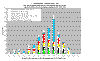 Chart
of Munsell value for intermedius
Chart
of Munsell value for intermedius Chart of
Munsell value of fuscus
Chart of
Munsell value of fuscus Map with clustered column
charts for Scandinavian location. Aggregate stacked charts.
Map with clustered column
charts for Scandinavian location. Aggregate stacked charts. LBBG fuscus 5cy C2ER,
July 09-17 2003, Tampere, Finland. Ringed in
Finland on July 03 1999. All primaries still old.
LBBG fuscus 5cy C2ER,
July 09-17 2003, Tampere, Finland. Ringed in
Finland on July 03 1999. All primaries still old. LBBG fuscus 5cy C7EU,
July 09-10 2003, Tampere, Finland. Ringed as pullus in Finland on July 04
1999. All primaries still old.
LBBG fuscus 5cy C7EU,
July 09-10 2003, Tampere, Finland. Ringed as pullus in Finland on July 04
1999. All primaries still old. LBBG fuscus 5cy CKP0,
July 09 2003, Tampere, Finland. Ringed as pullus in Finland on July 01
1999. P1 missing, P2-P10 old.
LBBG fuscus 5cy CKP0,
July 09 2003, Tampere, Finland. Ringed as pullus in Finland on July 01
1999. P1 missing, P2-P10 old. LBBG fuscus 6cy CAA1,
July 09-11 2003, Tampere, Finland. Ringed as pullus in Finland on July 11
1998. P1 new, P2 growing, P3-P10
old.
LBBG fuscus 6cy CAA1,
July 09-11 2003, Tampere, Finland. Ringed as pullus in Finland on July 11
1998. P1 new, P2 growing, P3-P10
old. LBBG fuscus 6cy CAW1,
July 12-15 2003, Tampere, Finland. Ringed as pullus in Finland on June 30
1998. P1-P5 fresh, P6-P10 older.
LBBG fuscus 6cy CAW1,
July 12-15 2003, Tampere, Finland. Ringed as pullus in Finland on June 30
1998. P1-P5 fresh, P6-P10 older. LBBG fuscus 6cy C3H4,
July 10-17 2003, Tampere, Finland. Ringed as pullus in Finland on July 09
1998. P9-P10 old, P10 with a large
mirror. Strong mahogany hue (chroma).
LBBG fuscus 6cy C3H4,
July 10-17 2003, Tampere, Finland. Ringed as pullus in Finland on July 09
1998. P9-P10 old, P10 with a large
mirror. Strong mahogany hue (chroma). LBBG fuscus 1cy CCVJ,
August 06-12 2002, Tampere, Finland. Medium dark brown
centres of scapulars and dark outer greater coverts. The fringes
are rather pale, almost white lacking a buff or yellowish hue.
LBBG fuscus 1cy CCVJ,
August 06-12 2002, Tampere, Finland. Medium dark brown
centres of scapulars and dark outer greater coverts. The fringes
are rather pale, almost white lacking a buff or yellowish hue.  LBBG fuscus 1cy CHR6,
August 06 2002, Tampere, Finland. Fringes of
the scapulars slightly worn. Very dark brown centres of
scapulars and very dark outer greater coverts. Most striking is the small
size & slender bill, but it's hard to
draw a clear line for identification.
LBBG fuscus 1cy CHR6,
August 06 2002, Tampere, Finland. Fringes of
the scapulars slightly worn. Very dark brown centres of
scapulars and very dark outer greater coverts. Most striking is the small
size & slender bill, but it's hard to
draw a clear line for identification. LBBG fuscus 1cy CCUR,
August 06-12 2002, Tampere, Finland. This bird and the
individual from the same nest, CCVJ, were still begging at the parent at the dump.
LBBG fuscus 1cy CCUR,
August 06-12 2002, Tampere, Finland. This bird and the
individual from the same nest, CCVJ, were still begging at the parent at the dump. LBBG fuscus 2cy C3VS,
July 16-17 2003, Tampere, Finland. Typical Finnish 2cy fuscus with 2nd generation primaries,
secondaries and tail.
LBBG fuscus 2cy C3VS,
July 16-17 2003, Tampere, Finland. Typical Finnish 2cy fuscus with 2nd generation primaries,
secondaries and tail. LBBG fuscus 2cy CJUC,
July 14-17 2003, Tampere, Finland. Advanced 2cy fuscus in Finland, moulting the inner primaries to
3rd generation. Tail and secondaries are 2nd generation.
LBBG fuscus 2cy CJUC,
July 14-17 2003, Tampere, Finland. Advanced 2cy fuscus in Finland, moulting the inner primaries to
3rd generation. Tail and secondaries are 2nd generation. LBBG fuscus 2cy MC24,
July 09-17 2003, Tampere, Finland.2cy fuscus from E
Sweden, reminiscent of Finnish fuscus in moult, but slightly more
powerful in jizz.
LBBG fuscus 2cy MC24,
July 09-17 2003, Tampere, Finland.2cy fuscus from E
Sweden, reminiscent of Finnish fuscus in moult, but slightly more
powerful in jizz. LBBG fuscus 2cy C5UJ, August
08 2002, Tampere, Finland. The average 2cy fuscus in Finland. P1-P9 moulted and the picture shows the abraded tip
of P10.
LBBG fuscus 2cy C5UJ, August
08 2002, Tampere, Finland. The average 2cy fuscus in Finland. P1-P9 moulted and the picture shows the abraded tip
of P10. LBBG fuscus CNMR, August 2002 (2cy) & July 2003 (3cy), Tampere, Finland. P10 still
juvenile in 2cy, moulting inner primaries in August. P10 2nd gen in 3cy,
again moulting inner primaries. As 2cy arrested moult in the secondaries.
LBBG fuscus CNMR, August 2002 (2cy) & July 2003 (3cy), Tampere, Finland. P10 still
juvenile in 2cy, moulting inner primaries in August. P10 2nd gen in 3cy,
again moulting inner primaries. As 2cy arrested moult in the secondaries. LBBG fuscus 2cy C6XV, August
07 2002, Tampere, Finland. Advanced 2cy fuscus: all primaries 2nd generation. Median
and inner greater coverts replaced for 3rd generation.
LBBG fuscus 2cy C6XV, August
07 2002, Tampere, Finland. Advanced 2cy fuscus: all primaries 2nd generation. Median
and inner greater coverts replaced for 3rd generation. LBBG fuscus 3cy C5XE,
July 10-16 2003, Tampere, Finland. Ringed in Finland on June 28
2001. P1-P3 new, P4 missing, P5-P10 old.
LBBG fuscus 3cy C5XE,
July 10-16 2003, Tampere, Finland. Ringed in Finland on June 28
2001. P1-P3 new, P4 missing, P5-P10 old. LBBG fuscus 3cy C5XM,
July 10-16 2003, Tampere, Finland. Ringed in Finland, now in 3cy.
Left wing: P1-P2 old 2nd generation, P3-P5
3rd gen, P6-P8 old 2nd gen, P9-P10 fresh 2nd gen.
LBBG fuscus 3cy C5XM,
July 10-16 2003, Tampere, Finland. Ringed in Finland, now in 3cy.
Left wing: P1-P2 old 2nd generation, P3-P5
3rd gen, P6-P8 old 2nd gen, P9-P10 fresh 2nd gen. LBBG fuscus 3cy C8CM,
July 09-11 2003, Tampere, Finland. Ringed as pullus at Ruoves,
Finland on July 04 2001, now in 3cy.
Primary moult arrested on P7.
LBBG fuscus 3cy C8CM,
July 09-11 2003, Tampere, Finland. Ringed as pullus at Ruoves,
Finland on July 04 2001, now in 3cy.
Primary moult arrested on P7. LBBG fuscus 3cy C8XC,
July 10-11 2003, Tampere, Finland. Ringed as pullus at Kanala,
Finland on June 28 2001, now in 3cy. Active moult in the inner primaries.
LBBG fuscus 3cy C8XC,
July 10-11 2003, Tampere, Finland. Ringed as pullus at Kanala,
Finland on June 28 2001, now in 3cy. Active moult in the inner primaries. LBBG fuscus 3cy C2A5,
July 10-17 2003, Tampere, Finland. Ringed as pullus at Palkan,
Finland on June 25 2001, now in 3cy. Primary moult arrested at P7.
LBBG fuscus 3cy C2A5,
July 10-17 2003, Tampere, Finland. Ringed as pullus at Palkan,
Finland on June 25 2001, now in 3cy. Primary moult arrested at P7. LBBG fuscus 3cy C0NM,
July 10-17 2003, Tampere, Finland. Ringed in Finland, now in 3cy.
Active moult in the inner primaries: P1
new, P2-P3 missing.
LBBG fuscus 3cy C0NM,
July 10-17 2003, Tampere, Finland. Ringed in Finland, now in 3cy.
Active moult in the inner primaries: P1
new, P2-P3 missing. LBBG fuscus 3cy C4XR,
July 09-17 2003, Tampere, Finland. Ringed in Finland, now in 3cy.
Primary moult arrested on P6.
LBBG fuscus 3cy C4XR,
July 09-17 2003, Tampere, Finland. Ringed in Finland, now in 3cy.
Primary moult arrested on P6. LBBG fuscus 4cy C0PA, July 11-17 2003, Tampere, Finland. Ringed at Luopio, Finland
on July 04 2000.
LBBG fuscus 4cy C0PA, July 11-17 2003, Tampere, Finland. Ringed at Luopio, Finland
on July 04 2000. LBBG fuscus 4cy C1CK, July 10-15 2003, Tampere, Finland. Ringed at Vilppu, Finland
on June 30 2000.
LBBG fuscus 4cy C1CK, July 10-15 2003, Tampere, Finland. Ringed at Vilppu, Finland
on June 30 2000. LBBG fuscus 4cy C1MS, July 10-17 2003, Tampere, Finland. Ringed at Luopio, Finland
on July 04 2000.
LBBG fuscus 4cy C1MS, July 10-17 2003, Tampere, Finland. Ringed at Luopio, Finland
on July 04 2000.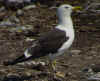 LBBG fuscus 4cy C1NU, July 16-17 2003, Tampere, Finland. Ringed at Luopio, Finland
on July 04 2000.
LBBG fuscus 4cy C1NU, July 16-17 2003, Tampere, Finland. Ringed at Luopio, Finland
on July 04 2000. LBBG fuscus 6cy C2H9,
August 2002 & July 2003, Tampere, Finland (61.33N 24.59E). Ringed as pullus at Palkan, Finland on July 09 1998, Sub-adult in 2002.
LBBG fuscus 6cy C2H9,
August 2002 & July 2003, Tampere, Finland (61.33N 24.59E). Ringed as pullus at Palkan, Finland on July 09 1998, Sub-adult in 2002. LBBG fuscus 4cy C3RH, July 07 2003, Tampere, Finland. Ringed in 2000.
 LBBG fuscus 4cy C5AR, July 10-17 2003, Tampere, Finland. Ringed at Sahala, Finland
on July 04 2000.
LBBG fuscus 4cy C5AR, July 10-17 2003, Tampere, Finland. Ringed at Sahala, Finland
on July 04 2000. LBBG fuscus 4cy C6MR, July 11-16 2003, Tampere, Finland. Ringed at Luopio in 2000.
 LBBG fuscus 4cy C6RA, July 09-15 2003, Tampere, Finland. Ringed at Luopio, Finland
on July 02 2000. Sub-adult fuscus by mid-July are very
adult-like. P1-P10 still old.
LBBG fuscus 4cy C6RA, July 09-15 2003, Tampere, Finland. Ringed at Luopio, Finland
on July 02 2000. Sub-adult fuscus by mid-July are very
adult-like. P1-P10 still old.  LBBG fuscus 4cy C7PA, July 09-17 2003, Tampere, Finland. Ringed in Luopio in 2000.