 nominate Lesser Black-backed Gull (L. f. fuscus)
(last update:
Amir Ben Dov (Israel)
Hannu Koskinen (Finland)
Mars Muusse (the Netherlands)
fuscus 1cy July
fuscus 1cy Aug
fuscus 1cy Sept
fuscus 1cy Oct
fuscus 1cy Nov
fuscus 1cy Dec
fuscus 2cy Jan
fuscus 2cy Feb
fuscus 2cy March
fuscus 2cy April
fuscus 2cy May
fuscus 2cy June
fuscus 2cy July
fuscus 2cy Aug
fuscus 2cy Sept
fuscus 2cy Oct
fuscus 2cy Nov
fuscus 2cy Dec
fuscus 3cy Jan
fuscus 3cy Feb
fuscus 3cy March
fuscus 3cy April
fuscus 3cy May
fuscus 3cy June
fuscus 3cy July
fuscus 3cy August
fuscus 3cy Sept
fuscus 3cy October
fuscus 3cy Nov
fuscus 3cy Dec
fuscus 4cy Jan
fuscus 4cy Feb
fuscus 4cy March
fuscus 4cy April
fuscus 4cy May
fuscus 4cy June
fuscus 4cy July
fuscus 4cy Aug
fuscus 4cy Sept
fuscus 4cy Oct
fuscus 4cy Nov
fuscus 4cy Dec
fuscus ad Jan
fuscus ad Feb
fuscus ad March
fuscus ad April
fuscus ad May
fuscus ad June
fuscus ad July
fuscus ad Aug
fuscus unringed Aug
fuscus ad Sept
fuscus ad Oct
fuscus ad Nov
fuscus ad Dec
Juvenile nominate fuscus from the breeding grounds in N Europe can be found in the sections August & September. Below, we describe migration to the wintering grounds from north Norwegian ring recoveries.
Migration patterns of adult and juvenile Lesser Black-backed Gulls Larus fuscus from northern Norway.
Five Norwegian authors, Morten Helberg, Geir Systad, Ingve Birkeland, Nils Lorentzen & Jan Bustnes published an article with this title in Ardea 97, 2009. The complete PDF can be found HERE.
In this section, we only describe in short the findings regarding juveniles.
Northern Norway: breeding ground for dark-mantled and pale-mantled LBBG
Traditionally, two subspecies of LBBG could be found in Norway: dark-mantled nominate fuscus in the north and pale-mantled intermedius in the south. Last decades, nominate fuscus breeding figures have dropped dramatically, while those figures for pale-mantled birds have increased. Nowadays (but already from the late 1980's) pale-mantled birds, either with origins in graellsii-land or colonisers from south Norwegian intermedius-land can be found way up in northern Norway.
Extensive ringing programmes in southern Norway show that juvenile intermedius follow the 'western flyway': from S Norway, through the North Sea bassin down along the Atlantic coast to the Iberian Peninsular and the west African coasts of Morocco and Mauritania. For north Norwegian populations, such migration research was unknown.
The three northernmost counties (Nordland, Troms and Finnmark) were visited from year 2000 onwards, to supply darvic rings to adults (June) and juveniles with body mass >300 gr (July). Darvic rings were used in 12 colonies, with varying numbers of breeding pairs (two pairs to 400 pairs). Three of these colonies held 'pure fuscus' while the other nine colonies held both fuscus and intermedius/graellsii in about equal portions (see Table 1).
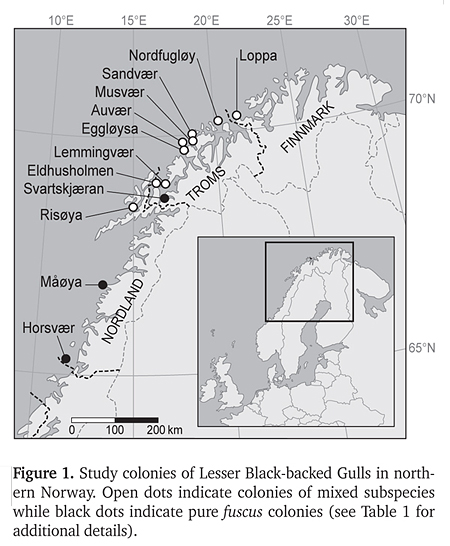
All resights up to May 2008 are included in this research. When pulli were ringed in mixed colonies, they could not be determined to subspecies.
Between 2000-2007, 1284 juveniles were colour-ringed. 83 birds (6.5%) were resighted in 20 countries. There was a slightly higher probability of resighting juveniles from mixed colonies (7.5%, n=749) than from pure fuscus colonies (4.9%, n=535).
30% were classified as eastern migrants (eastern flyway through Finland, Black Sea, Israel to the Rift Valley) and 70% were western migrants (see figure 2, click on image for enlargement). The direction of migration was irrespective of the colony type (70% and 74% of the juveniles were western migrants in mixed and fuscus colonies respectively).
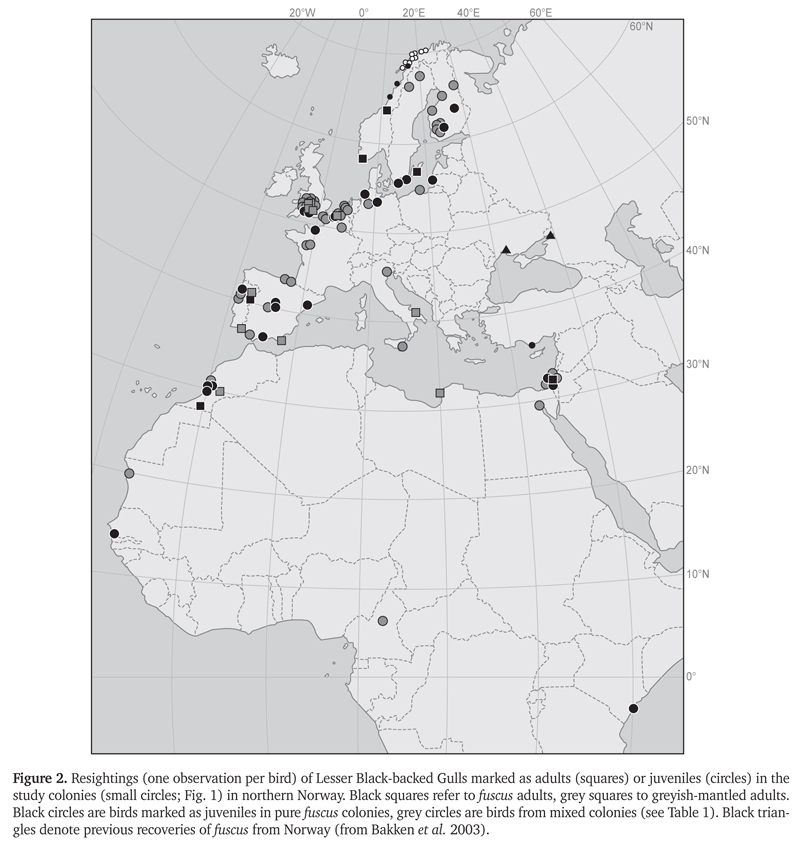
42 juveniles were seen in winter (1 November - 31 March). 29 from mixed colonies, 13 from fuscus colonies, in 12 countries. 83% of the birds were seen along the western migration route, and there was no difference between colony type. 23 juveniles (79%) from mixed colonies were seen in an area between England/France and Mauritania, 2 in Italy, 2 in Israel and 1 in Cameroon. From pure fuscus colonies, 11 were found between England and Senegal, 1 in Israel and 1 in Kenya. If birds were seen in consecutive years, it was often from the same wintering location again. Winter site fidelity appears to be high.
The probability of resightings from birds following a western route is much higher than from birds following an eastern route, as there are less observers along the eastern route. Hence, the actual proportion of juvenile birds following an eastern route will be much higher. Nevertheless, it is surprising that most of the juveniles from pure fuscus colonies (74%) had a western migration.
Table:
| Table 1: Location of LBBG study colonies in N Norway (see fig 1). Abstraction of juvenile data. |
||||||
Location: |
# breeding pairs: |
population composition: |
% L. f. fuscus |
years of ringing |
marked |
recovered |
Loppa |
50 |
mixed |
40-60 |
2003-07 |
112 |
14 |
Nordfugloy |
100 |
mixed |
40-60 |
2000-07 |
147 |
20 |
Sandvaer |
8 |
mixed |
40-60 |
2005-07 |
7 |
0 |
Musvaer |
20 |
mixed |
40-60 |
2007 |
32 |
3 |
Auvaer |
20 |
mixed |
40-60 |
2005-07 |
59 |
4 |
Eggloysa |
8 |
mixed |
40-60 |
2003-07 |
13 |
1 |
Froholman |
45 |
mixed |
40-60 |
2005-07 |
157 |
3 |
Lemmingvaer |
45 |
mixed |
40-60 |
2002-07 |
222 |
11 |
Svartskjaeran |
10 |
pure |
100 |
2005-07 |
26 |
1 |
Risoya |
2 |
mixed |
50 |
2003 |
0 |
- |
Maoya |
25 |
pure |
100 |
2002 |
0 |
- |
Horsvaer |
400 |
pure |
100 |
2005-07 |
509 |
26 |
Total: |
733 |
1284 |
83 |
|||
| Population composition: Mixed = pale and dark-mantled bird breeding together; Pure = only nominate fuscus. | ||||||
 L. f. fuscus 1cy CH6R October 09 2014, Ashdod, Israel. Picture: Amir Ben Dov.
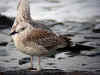 L. f. fuscus 1cy CXVA October 16 2004, Westkapelle, the Netherlands.A slightly worn juvenile fuscus. Picture Jaco Walhout.
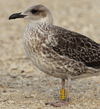 L. f. fuscus 1cy C51X October 01 2011, Ashdod, Israel. Picture: Amir Ben Dov. Replacing scapulars.
 L. f. fuscus 1cy CJ62 October 25 2009, Ma'agan Mikhael, Israel. Picture: Rami Mizrachi.
 L. f. fuscus 1cy HT 260314 October 12 2008, Tampere, Finland. Picture: Hannu Koskinen. Juvenile fuscus.
 L. f. fuscus 1cy SVS 8115661 October 12 2008, Tampere, Finland. Picture: Hannu Koskinen. Juvenile fuscus.
 L. f. fuscus 1cy JLH2 October 12 2008, Tampere, Finland. Picture: Hannu Koskinen. Juvenile fuscus.
 L. f. intermedius 1cy J5V1 October 27 2007, Amsterdam, the Netherlands. Picture: Ruud Altenburg. Juvenile intermedius from contact zone in N Norway. Also seen as 2cy in May.
 L. f. fuscus 1cy, October 01 2011, Ashdod, Israel. Picture: Amir Ben Dov. Classic contrasting juvenile fuscus.
 L. f. fuscus 1cy October 02 2009, Ashdod, Israel. Picture: Amir Ben Dov. Juvenile plumage.
 L. f. fuscus 1cy, October 07 2011, Ashdod, Israel. Picture: Amir Ben Dov. Juvenile fuscus.
 L. f. fuscus 1cy, October 07 2011, Ashdod, Israel. Picture: Amir Ben Dov.
 L. f. fuscus 1cy, October 01 2011, Ashdod, Israel. Picture: Amir Ben Dov.
 Larus
fuscus fuscus 1cy, October 01 2011, Koukkujärvi, Finland.
Larus
fuscus fuscus 1cy, October 01 2011, Koukkujärvi, Finland. L. f. fuscus 1cy, October 07 2011, Ashdod, Israel. Picture: Amir Ben Dov. Juvenile fuscus.